

 FP0142 : Multifocal intraocular lens implantation in pediatric eyes
Dr.MINNU PARAKAL
Dr. SWAPNA NAIR, Dr.Ashwin Mohan
Semi Finals
Abstract
Aim: To study clinical outcomes of multifocal intraocular lens implantation (MFIOL) in pediatric eyes.
Methods: In this prospective interventional study, children undergoing cataract surgery were included between Aug 2017 to Dec 2019. A comprehensive exam was conducted prior to surgery and surgical complications and visual improvement were analyzed.
Results: 21 eyes (14 patients) with a mean age of 5.2 (range 1-14) years were included. 9 eyes had raised IOP which normalized by 1 week. Mean residual spherical power was 0.26 D and astigmatism was -0.22 D; mean Snellen’s corrected distant vision was 6/12 and uncorrected near vision ranged from N6-N8. 3 developed visual axis opacification (mean 5 months post-surgery). All verbal children (n=15) had average contrast sensitivity of 1.5 and Stereopsis 600-40 sec of arc post-surgery.
Conclusion: MFIOL showed favorable clinical outcomes in this pediatric age group.
Full Text
INTRODUCTION
Paediatric cataract accounts for 7.4%–15.3% of childhood blindness [1] and a significant amount of avertable disability-adjusted life years. There is no gender or laterality based difference in the prevalence.[2] India has a burden of around 280,000–320,000 visually impaired children.[3]
Preoperative factors play an important role in the postoperative outcomes in children. The age of onset, type of cataract, laterality, delay in presentation, best-corrected distance visual acuity at presentation, the presence of strabismus, nystagmus, and glaucoma are all predictors of postoperative visual outcomes.[4] The delay in presentation for surgery is associated with poor outcomes. Bilateral cataract has better visual outcome compared to unilateral cataract, 78% of the children with bilateral cataract had more than 0.3 visual acuity.[4]
Age at which an Intra-ocular lens (IOL) can be implanted is a controversial issue. Implantation of an IOL in very young children carries the risk of severe postoperative inflammation, posterior capsule opacification and secondary glaucoma that may require more surgeries.[4] Accuracy of the IOL power calculation is affected by the small size of eyes and the steep keratometric values at this age. Furthermore, choosing an appropriate IOL power is not a straight forward decision as future growth of the eye may result in an unexpected refractive error as children age. There are very few studies that have documented the implantation and subsequent results of multifocal IOL’s.
AIM OF THE STUDY
The study aims at understanding the merits and demerits of implanting a Multifocal IOL after cataract extraction in the pediatric group. This study analyses the visual outcome after surgery, the behaviour of lens inside the eye, the reaction of eye after surgery and the possible intra-operative and post-operative complications. It also assess the visual performance of the child in scotopic and photopic conditions, in day to day life.
METHODS
This was a prospective interventional study done in a tertiary hospital in Kerala during the time period from August 2017 to December 2019. 21 eyes of 14 children who developed cataract were included in the study. They were in the age group of 1 year to 14 years. The ethical standards as outlined by the Medical Research Council were followed when contacting patients. A well informed consent was taken from the patients’ parents and the study protocol was approved by the ethics committee. The age of the patient, cause for cataract, laterality, preoperative and postoperative uncorrected and corrected distance and near visual acuity, axial length, slit lamp observations, preoperative and postoperative intraocular pressures, age of surgery, type of surgery, postoperative IOL positioning, intra and post operative complications and quality of life estimation were recorded. All patients were followed up for a minimum of 3 months post surgery. All children were adviced to undergo part time occlusion of the normal eye in case of unilateral cataracts and alternate eyes in case of bilateral cataracts, the time period of which was determined based on resistance to occlusion in preverbal children and on visual acuity in older ones.
Visual acuity was assessed by Snellen’s chart in older children, LEA symbol chart in pre school children, Bock’s candy bead test, Langs stereopsis chart and fixation quality and preference (CSM) in preverbal children. Contrast sensitivity was assessed by Pelli Robson contrast sensitivity chart in older children.
In younger children, ultrasound biometry under ketamine sedation was done and SRK II formula was used for IOL power calculation. In older children, optical biometry was done as an OP procedure and Barrett’s universal formula was used. Children of 5yrs and more were implanted the same IOL power as calculated. In children less than 5yrs of age, eye was undercorrected by 10%. All underwent primary IOL implantation under general anaesthesia. Bilateral cataract patients underwent cataract extraction in both eyes simultaneously with IOL implantation.
Steps of the surgery: Under sterile precautions, superior 3mm scleral incision and sclerocorneal tunnel was made. Paracenteses were made at 9.30 o clock and 2.30 o clock position. After staining the anterior capsule with Trypan blue, anterior continuous curvilinear capsulorhexis was done with a rhexis forceps, the pull directed centrally. Lens was aspirated with an irrigation-aspiration handpiece. Posterior continuous curvilinear capsulorhexis (PCCC) along with anterior vitrectomy were done. A single piece hydrophobic yellow chromophore containing acrylic multifocal IOL was inserted into the capsular bag. Remaining visco-elastic substance in AC was washed off and the corneal incisions were sutured after a peripheral iridectomy.
Posterior continuous curvilinear capsulorhexis and anterior vitrectomy was done in all except 4 eyes. The multifocal IOL used were MF Restor with add of +3D, and Tecnis MF with add of +4D for near vision correction.
Post operative IOL positioning was evaluated with respect to the number of rings exposed on either side of the IOL centre in the pupillary area. Presence of IOL glistening on slit lamp examination was noted. Slit lamp examination was done using either the handheld or standard slitlamp microscope.
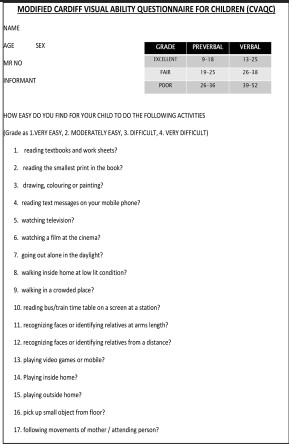
For assessing the quality of life after cataract surgery, a questionnaire was prepared and it was modified Cardiff Visual Ability Questionnaire for Children.(chart 1)
SPSS ver21 was used for data analysis and the outcomes were documented.
RESULTS
21 eyes of 14 pediatric patients in the age group of 1 to 14 years were included in this study, out of which 7 children underwent bilateral surgery. The average axial length was 22.53mm, ranging between 20.2mm and 26.87mm with a standard deviation of 1.74.
The average age at which IOL implantation was done was 5.19yrs, ranging from 1 to 14 years. All except 3 underwent primary IOL implantation. The average multifocal intraocular lens (MFIOL) power was 23.07D +/- 4.09D. The lowest MFIOL power implanted was 14.5D in a 14 year old child.
Table 1: Comparison of pre operative and post operative distant vision
| Distant | n | LogMar Mean | SD | p-value |
| PRE OP VN | 21 | 0.8 (6/38) | 0.30 | <0.001 |
| POST OP VN | 21 | 0.3 (6/12) | 0.34 |
p-value <0.05 , there is significant improvement in distant vision. (preop vn- preoperative vision)
Table 2: Comparison of pre operative and post operative near vision
| Near | n | LogMar Mean | SD | p-value |
| PREOP VN | 15 | 0.5 (N10) | 0.24 | 0.027 |
| POST OP VN | 15 | 0.3 (N6) | 0.12 |
p-value <0.05 , there is significant improvement in near vision. (postop vn- post operative vision)
The logmar best corrected visual acuity for distance and near (courtesy: David B, Elliott and John G Flanagan. Assessment of visual function. Ophthalmology, published on 08/03/2015) improved in 100% of eyes. The average corrected distant visual acuity was 0.3 (6/12) and average near vision was 0.3 (N6) without near addition. 66.7% cases had post surgery uncorrected distant vision of 6/12 or better and 73.3% had uncorrected near vision of N8 or better. The average residual spherical power was 0.26DS and astigmatism was -0.22DC.
The age at which IOL implantation was done and the percentage of improvement of vision in each eye were studied and the correlation between the two was analysed. There was no correlation noted between the two in our study.
Table 3: correlation of age of surgery with vision improvement
| Age of surgery | Change in Distance vn | change in near vn |
| Pearson Correlation | 0.147 | -0.404 |
| p-value | 0.525 | 0.217 |
| n | 21 | 15 |
No correlation with age and vision improvement.
The average contrast sensitivity in verbal children post surgery was 1.5. Stereopsis was attained in all verbal children (600-40sec of arc).
No intra-operative complications occurred in any of the cases. No IOL decentration was noted in any of the cases at follow up visits. There was transient rise in intraocular pressure (IOP) in 9 eyes immediate post surgery, but became normal within 1 month. The average IOP at 1 month was 13.71mmHg. Three patients developed visual axis opacification and underwent Nd: YAG capsulotomy at an average of 5 months post surgery.
The quality of life questionnaire indicated satisfactory levels of performance at school and play, and in both photopic and scotopic light conditions. There was no indication of intolerance to light or poorer performances in low light situations.
DISCUSSION
The visual prognosis for children with congenital cataracts has improved dramatically since it was first recognised that cataract surgery during infancy is critical for a good visual outcome;[5,6] however, the optimal time to perform the surgery is still in question. Anecdotal reports have noted excellent visual outcomes in neonates undergoing cataract surgery during the first week of life[5,7]; however, a subsequent analysis of 45 children with dense unilateral cataracts, who underwent cataract surgery, found that the visual outcome was the same regardless of when the surgery was performed during the first 6 weeks of life.[8] While the same analysis has not been performed on children with bilateral congenital cataracts, it has been proposed that the critical period for treating children with bilateral congenital cataracts may extend to 8 weeks of life.[6,9,10] Paediatric ophthalmologists are now trying to determine the optimal time to perform cataract surgery to reduce the high incidence of complications that have been reported following cataract surgery during infancy. Owing to the giant leap in cataract surgery technology and technique of pediatric cataract surgery, the post surgery complications are now few.
According to Infant Aphakia Treatment Study(IATS), there was no significant difference in visual acuity at age one year between those who underwent primary IOL implantation and those who were left aphakic and given contact lens correction, though the IATS found a higher number of surgeries in children who had IOLs at <1year.[11] Despite controversy,[12] IOLs are implanted in infants with increasing frequency. Some have advocated surgery based on age as follows: 1.Infants less than 6 months to undergo lens aspiration, primary posterior capsulectomy and anterior vitrectomy. IOL implantation in children less than 6 months is still controversial.[13]2.Primary IOL implantation is to be the standard of care in patients over two years of age. There is increasing evidence of safety in those less than 2 years.[14] A survey by the American Association for Pediatric Ophthalmology and Strabismus reported an increase in IOL implantation in children less than 2 years from 12.9% to 81.9% from 1993 to 2001. Some have advocated implanting IOLs at an even younger age less than 6 months in cases of unilateral cataract with no contraindications such as micropthalmia or structural abnormality.[15] Ledoux et al. reported a 14 year retrospective review of 239 children (aged 11 days to 17 years), with unilateral and bilateral cataracts who underwent primary IOL implantation.[16] They found approximately 75% achieved 0.3 vision or better and with better outcomes in bilateral cases and in children who were older than 1 year prior to IOL implantation.[16] In a retrospective study of 400 patients with 87% of the cohort undergoing primary IOL implantation, Congdon et al. reported that 40% achieved 20/60 vision or better.[17] Congdon et al. concluded that IOL implantation with spectacle correction predicted a better visual outcome.[17] A study of primary IOL implantation in 120 eyes of 80 children below 2 years of age concluded that IOLs were safe and can be considered as a viable option for visual rehabilitation.[17] We have found that all children increased their visual acuity from an average of 0.8 to 0.3, including very young and old children. The youngest children to be implanted in our study was 1yr old, as we follow a protocol of aphakia and contact lens post cataract surgery below 1 year of age. The oldest child was 14 year old and though she underwent surgery beyond the age of plasticity, her vision did improve substantially from 1 to 0.6. This could be because of a progressive developmental cataract rather than a stationery congenital cataract that may be less amblyogenic.
Multifocal IOLs provide good near and distance vision [18] and also help in establishing stereopsis in unilateral cases,[19] but the brightness and contrast of the images get compromised.[18] Any decentration of lens leads to glare, halos, and deterioration in the quality of the image. The spectacle independence should not be expected with multifocal IOLs in children, but the multifocal IOL provides independence from bifocals and will still be able to provide distance vision correction with refractive surgery in the patients’ adult future. Also, as near vision is more important to ward off refractory amblyopia, IOLs which provide good near vision also are likely to be a better option.
Jacobi et al[12] report on their experience implanting multifocal IOLs in 35 eyes of 26 pediatric patients aged 2 to 14 years. They suggest that for children, multifocal IOLs are a viable alternative to the standard monofocal IOL. However, this study has limitations. The reported benefit of improved stereopsis may come from improved acuity. Data on spectacle dependence and subjective satisfaction are not helpful when obtained from children, who will understate their symptoms in the hope of avoiding glasses. The average follow-up of 27 months (range, 12–58 months) is good for adults but is not sufficient for pediatric patients.
In our patients, the parents were given a choice of monofocals and multifocals, with the advantage of multifocals being added near visual acuity. They were counselled about additional distance and near glasses also, though most children required correction for astigmatism and none required near augmentation. This itself may show that correcting near vision in the IOL may be a more physiological means for children than giving bifocals.
Lee ES et al [20] studied the visual acuity (VA) and patient satisfaction after implantation of Array SA40N multifocal intraocular lens (IOL) (AMO) in adult polpulation. Three months postoperatively, uncorrected distant and near vision, uncorrected distant vision under glare conditions, and contrast sensitivity were good in all eyes and more than 72% of patients never wore glasses for near vision.
In our study, the good reference with respect to contrast assessment is an indication of the tremendous adaptability of children’s eyes to light distribution by the IOL and resultant aberration like glare, as even the older children failed to report it when questioned directly.
3 of 21 eyes (14%) developed visual axis opacification though they had already undergone posterior capsulorhexis (PCCC). This could be because of inadequate anterior vitrectomy that would have provided a scaffold for lenticular tissue to proliferate.
IOP rose only transiently in 9 eyes immediate post surgery. This could have been because of retained OVD’s, steroid response or an immediate inflammatory response. None of the children had a primary glaucoma and we were able to achieve normal IOPs after a brief period of treatment of transient glaucoma.
The inadequacy of the study include, 1.Short period of follow up being 3 months for some eyes, 2.Small sample size, 3.Difficulty in extracting qualitative information from children in terms of abstract phenomena like dysphotopsia and glare associated with diffractive multifocals is also an impediment.
CONCLUSION
For children, near vision is more important than distant vision, as they need clear near vision for their daily activities like playing, drawing, etc. Smaller children may not be compliant with spectacle or contact lens use, especially when having working parents. Also children with bifocals may not use the spectacle segments properly. All these are causes for amblyopia.
Multifocal IOL implantation is a better alternative to monofocal IOL for paediatric cataract as the patient has good near vision postoperatively, without using a bifocal glasses. This prevents development of amblyopia in such patients. The post operative complication rate associated with IOL was virtually nil in our study and a high degree of visual improvement was obtained.
REFERENCES
- Rahi JS, Sripathi S, Gilbert CE, Foster A. Childhood blindness in India: Causes in 1318 blindschoolstudentsinninestates.Eye(Lond)1995;9(Pt5):545-50.
- Sheeladevi S, Lawrenson JG, Fielder AR, Suttle CM. Global prevalence of childhood cataract: A systematic review. Eye (Lond)2016;30:1160-9.
- Titiyal JS, Pal N, Murthy GV, Gupta SK, Tandon R, Vajpayee RB, et al. Causes and temporal trends of blindness and severe visual impairment in children in schools for the blind in North India. Br J Ophthalmol 2003;87:941-5.
- Bonaparte LA, Trivedi RH, Ramakrishnan V, Wilson ME. Visual acuity and its predictors after surgery for bilateral cataracts in children. Eye (Lond) 2016;30:1229-33.
- Beller R , Hoyt CS. Good visual function after neonatal surgery for congenital monocular cataracts. Am J Ophthalmol 1981;91:559–65.
- Gelbart SS, Hoyt CS, Jastrebski G, et al.Long-term visual results in bilateral congenital cataracts. Am J Ophthalmol 1982;93:615–21.
- Gregg FM, Parks MM. Stereopsis after congenital monocular cataract extraction. Am J Ophthalmol1992;114:314–17.
- Birch EE, Stager DR. The critical period for surgical treatment of dense congenital unilateral cataract. Invest Ophthalmol Vis Sci 1996;37:1532–8.
- Lundvall A , Kugelberg U. Outcome after treatment of congenital bilateral cataract. Acta Ophthalmol Scand 2002;80:593–7.
- Magnusson G , Abrahamsson M, Sjöstrand J. Changes in visual acuity from 4 to 12 years of age in children operated for bilateral congenital cataracts. Br J Ophthalmol 2002;86:1385–9.
- Infant Aphakia Treatment Study Group: The infant aphakia treatment study: design and clinical measures at enrollment. Arch Ophthalmol 2010;128:21-7.
- Wilson ME, Trivedi RH. Pediatric cataract surgery: Operative and postoperative issues. In: Wilson ME, Saunders RA, Trivedi RH, editors. Pediatric Ophthalmology: Current Thought and A Practical Guide. Germany: Heidelberg, Germany; 2009. p. 326–43, Chapter23.
- Rao SK, Ravishankar K, Sitalakshmi G, Ng JS, Yu C, Lam Ds. Cystoid macular edema after pediatric intraocular lens implantation:fluorescein angioscopy results and literature review. J. CataractRefract Surg 2001;27(3):432–6.
- Fan SPD, Yip WK, Christopher BY, Rao SK, Lam DSC. Updates on the surgical management of pediatric cataract with primary intraocular lens implantation. Annal Acad Med 2006;35:8.
- Wilson ME, Bartholomew LR, Trivedi RH. Pediatric cataract surgery and intraocular lens implantation: practice styles and preferences of the 2001 ASCRS and AAPOS memberships. J Cataract Refract Surg 2003;29(9):1811–20.
- Ledoux DM, Trivedi RH, Wilson Jr ME, Payne JF. Pediatric cataract extraction with intraocular lens implantation: visual acuity outcome when measured at age four years and older. J AAPOS 2007;11(3):218–24.
- Congdon NG, Ruiz S, Suzuki M, Herrera V. Determination of pediatric cataract program outcomes and follow-up in a large series in Mexico. J Cataract Refract Surg 2007;33(10):1775–80.
- Jacobi PC, Dietlein TS, Konen W. Multifocal intraocular lens implantation in pediatric cataract surgery. Ophthalmology 2001;108:1375-80.
- Lapid-Gortzak R, van der Meulen IJ, Jellema HM, Mourits MP, Nieuwendaal CP. Seven-year follow-up of unilateral multifocal pseudophakia in a child. Int Ophthalmol 2017;37:267-270.
- Lee ES, Lee SY, Jeong SY, et al. Effect of postoperative refractive error on visual acuity and patient satisfaction after implantation of the Array multifocal intraocular lens. J Cataract Refract Surg. 2005;31:1960–1965.
Leave a Comment